

If the thought of lying inside an MRI scanner makes you uneasy, you are not alone, and it is worth saying so early. MRI claustrophobia, the fear of being in a closed space, is something imaging teams hear about regularly. Tell the imaging facility before your appointment, not for the first time when you are on the table. An advance conversation gives the team a chance to understand what worries you and explain how your exam will work.
No two MRI experiences are identical, because scanners and exams vary. If imaging is part of your spine care, talk to the Long Island Spine Specialists physicians about why an MRI has been suggested and what follows. Let the doctor who ordered your scan and the imaging facility both know if your concern could affect completing the appointment.
Explain what worries you in plain words
“I'm claustrophobic” is a good start, but a little more detail can help staff respond. Maybe it is the enclosed space itself. Maybe it is being unable to see the room, not knowing how you will communicate, or the memory of a hard scan in the past. You don’t need medical language. Just say which part bothers you most.

If you have had an MRI before, describe what happened without assuming this one will go the same way. Which part was manageable? At what point did you feel uncomfortable? What did you wish someone had explained? A few specific details are more useful than a general prediction that the appointment will go badly.
You can write the explanation down if making the call feels difficult. For example: “I have an MRI appointment coming up, and I am worried about the enclosed space. I would like to discuss how the exam will work before I arrive.”
Lying still when your back or neck hurts
For people with spine problems, the worry is often not only the space but also staying still. UCSF’s radiology department notes that some patients expect to be uncomfortable because of back pain, breathing problems or other reasons, and says they should ask their doctor to help develop a plan. If lying flat for a period of time is a concern, tell your doctor and the imaging team ahead of time, in your own words. They can explain what the exam involves for the part of your body being scanned.
Know what to expect from the exam
Knowing what the exam involves can take some of the mystery out of it. UCSF explains that its patients should expect clicking or banging sounds, which are a normal part of every MRI, and that they will be asked to hold relatively still. How long the exam takes depends on what is being imaged.
Details like lighting, ventilation, how open the scanner is, and whether you can watch a video vary by facility. UCSF describes what it offers at its own medical center, and those details do not tell you what another facility has. Ask the one you are booked with about its actual scanner and what to expect for your exam.
Photos online can also mislead. Avoid booking a different scanner only because an advertisement uses words such as “open” or “wide.” The question is whether the plan meets your needs and the requirements of the exam, not which label sounds least intimidating.
Understand how to communicate during the exam
Before the scan starts, ask staff to show you how you will communicate. A general assurance that someone is nearby may not answer the practical question on your mind. Ask how to get attention, how instructions will be delivered and what to do if you become uncomfortable.
You can also ask what will happen between parts of the exam. Some useful questions:
- How will I hear you, and how will you hear me?
- How do I signal that I need your attention?
- What should I expect during positioning and the scan sequence?
- Who should I speak with if I am unsure I can complete the exam?
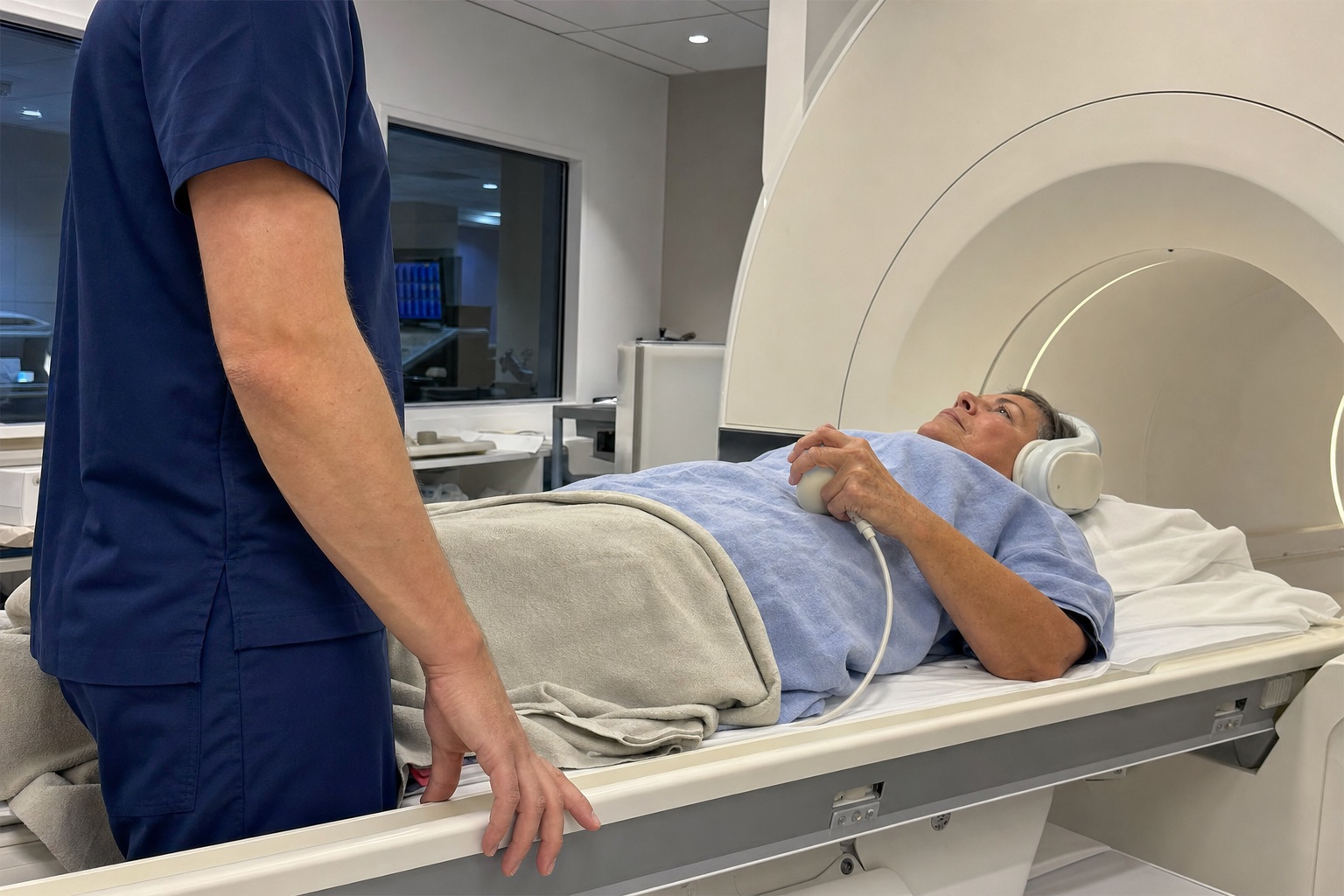
For example, describes a speaker system inside the scanner and a squeeze-ball call button. Every facility’s setup is different, so ask about yours.
Make a plan with your care team
Explain previous difficulties and any instructions you have already received so that they can discuss a coordinated plan. If a clinician provides specific instructions, clarify them before the day of the scan. Ask whether they affect your arrival time, who can come with you, or how you will get home. Do not borrow another person's medicine or copy the preparation used for someone else's appointment. Your team needs to account for your own circumstances.
If you hope to bring a friend or relative, ask what the facility permits and what screening or other requirements apply. Being allowed into the waiting area is not the same as being allowed into the scan room, so confirm which one applies.
Keep a short plan for the day
Write down the facility's phone number, the name of the person you spoke with if available, the concern you discussed and any instructions the team gave you. Bring the required paperwork and screening information as directed. Tell staff again about the concern when you arrive so that the conversation is not lost between scheduling and the scan.
A good last question to ask before you begin is, “Is there anything we still need to decide?” That gives you a chance to clarify an unanswered point. You do not need to apologize for asking how the process works, and you do not need to pretend a worry has disappeared simply because the appointment has started.
If you are on Long Island and have questions about spine imaging, contact Long Island Spine Specialists or call (631) 837-2359 and ask whom to speak with about your plan, then confirm the practical details directly with your imaging facility. Preparation can’t promise a particular experience, but it can replace unanswered questions with a plan that fits you.